
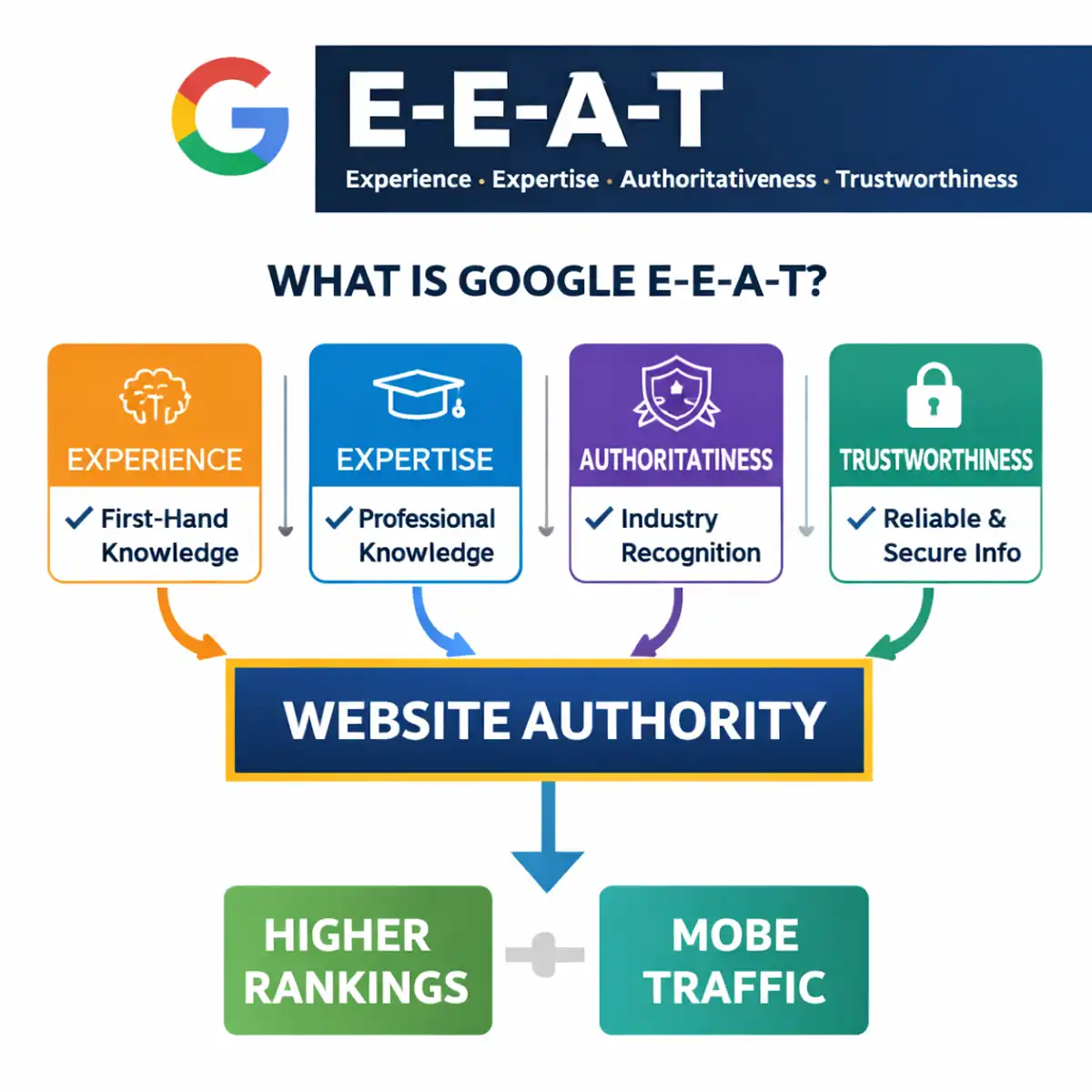
E-E-A-T — Experience, Expertise, Authoritativeness, Trustworthiness — is among the most cited frameworks in SEO content strategy and, simultaneously, one of the most imprecisely applied. The imprecision has a specific origin: Google's Search Quality Rater Guidelines, where E-E-A-T is documented in detail, are instructions for human quality raters who evaluate search results for Google's research purposes. They are not the algorithm. The relationship between what raters assess and what the ranking algorithm measures is indirect and not fully specified in any public documentation.
The December 2025 core update sharpened the practical relevance of E-E-A-T for UK publishers significantly. Google's communications associated with that update indicated that quality signals broadly aligned with the E-E-A-T framework now apply across all competitive search categories, not only the Your Money or Your Life content types that had traditionally been the primary E-E-A-T focus. For UK sites in professional services, technology, retail, home improvement, and legal verticals — categories where the YMYL designation had previously been ambiguous — the December 2025 update raised the quality threshold across the board.
This article applies the confirmed-vs-speculative distinction to E-E-A-T signals with specific attention to the UK regulatory and professional context that US-origin E-E-A-T content systematically omits.
What Google has confirmed about E-E-A-T and what it has not
Google has confirmed that its quality rater guidelines use E-E-A-T as an evaluation framework, and that algorithmic systems attempt to reward content that demonstrates these qualities. Google has also confirmed that Trustworthiness is the most important component of E-E-A-T: a page that scores highly on Experience and Expertise but is untrustworthy — through misleading information, obscured authorship, or unclear commercial relationships — is rated lower overall than a page with modest expertise signals but clear, accurate information and transparent sourcing.
What Google has not confirmed is a specific list of on-page signals that directly correspond to E-E-A-T scores in the ranking algorithm. The practitioner claims that author bylines with linked author bios are a direct ranking factor, that a minimum biography word count improves E-E-A-T, and that specific schema markup types raise E-E-A-T scores are not in Google's documentation. These are plausible hypotheses based on logical alignment with what quality raters look for, but they are not confirmed mechanisms. Acting on them is reasonable; presenting them as confirmed ranking factors is an accuracy problem that the SEO community perpetuates widely.
The confirmed signal framework that is most defensible: Google's documentation confirms that it evaluates the reputation of the site and author as assessed by third parties — editorial mentions, cited expertise, linked credentials — rather than relying solely on self-declaration. A site that claims expertise on its About page without external corroboration is treated differently from a site whose authors are cited in industry publications or whose content is referenced by organisations in the relevant field. This is the confirmed E-E-A-T signal most practitioners underinvest in relative to on-page declarations of expertise.
Fun fact: The original E-A-T framework (Experience was added in December 2022, creating E-E-A-T) first appeared in Google's Search Quality Rater Guidelines in 2014; it took eight years for the concept to become central to SEO practitioner discussion, largely because the guidelines were not publicly available until Google released them in 2015.
UK-specific trust signals that the E-E-A-T framework confirms
The Trust component of E-E-A-T has a specific UK dimension that most E-E-A-T content, written from a US context, does not address. Google's quality rater guidelines reference the verification of factual accuracy and the clarity of who is responsible for the content as primary trust signals. In the UK, several regulatory frameworks provide independent, verifiable trust signals that US sites do not have access to: ICO registration for sites that process personal data, FCA authorisation or appointed representative status for sites providing financial information, and SRA registration for legal content sites.
For UK sites in these regulated verticals, the presence of regulatory registration numbers, ICO registration confirmation, FCA reference numbers, and SRA identifiers represents a form of third-party trust validation that is more credible than a generic privacy policy or a "we take your privacy seriously" statement. These are verifiable by any quality rater or algorithmically via entity matching. Including ICO and FCA reference numbers in the site's footer, About page, and relevant service pages is the UK-specific implementation of the Trust component that US E-E-A-T guidance does not contemplate.
The ASA (Advertising Standards Authority) context is relevant for content that makes commercial claims. UK sites making comparative claims about products or services are subject to ASA guidelines on truthfulness and substantiation. Content that makes evidence-based comparative claims with verifiable data sources is more consistent with E-E-A-T's Trustworthiness standard than content making unsubstantiated superlatives. This is not an algorithmic claim; it is an alignment between UK regulatory best practice and the editorial standard Google's quality framework describes.

The Experience component and what it requires in practice
Experience was added to E-A-T in December 2022, creating E-E-A-T, with Google's documentation noting that content demonstrating first-hand experience with the topic it covers is valuable even when the author is not a formally credentialled expert. A product review written by someone who has used the product is assessed differently from a product review written from the manufacturer's specifications alone. A travel article written from a personal visit is assessed differently from one synthesised from other travel articles.
The practical implementation of Experience for UK editorial sites involves decisions that are genuinely editorial rather than technical. Where does the content draw on the author's or the organisation's direct knowledge? Where is the content synthesised from secondary sources without first-hand grounding? This distinction is not about adding a "From personal experience..." sentence at the top of every article; it is about the underlying content production model. An SEO agency blog that writes about technical SEO challenges from the perspective of practitioners who work on real client accounts has an Experience signal that a content farm writing about the same topics from general research does not, and that distinction becomes harder to fake as Google's quality systems improve.
For Teksyte's editorial platform specifically, the Experience signal is most credible in content that draws on actual client diagnostic work — real patterns observed in Search Console data, real crawl anomalies identified in agency audits, real Core Web Vitals scenarios from implementation projects. Content grounded in this kind of practitioner experience is not only more useful to readers; it is structurally differentiated from content that any well-resourced content producer could generate.
Authoritativeness: how Google assesses it and where practitioners focus incorrectly
Authoritativeness in Google's framework is fundamentally about how other entities in the relevant field regard the site and its authors. It is a network property rather than an on-page property. Google's documentation references editorial mentions, citations by credible sources, and the reputation the site has built in its field as the relevant signals. This is why external link building strategy, editorial partnerships, and being cited as a source by other practitioners in the field are more directly aligned with the Authoritativeness component than any on-page optimisation.
The practitioner's tendency to address Authoritativeness through on-page declarations — comprehensive author bios, credential listings, years of experience statements — is not wrong, but it addresses the proxy rather than the signal. An author bio that states 15 years of experience is not verifiable by Google in the same way that 15 mentions of the author's work in Search Engine Land, Moz Blog, or other industry publications is verifiable. The on-page bio tells readers what the author claims; the citation network tells Google what the field has determined. Invest proportionally.
Start with the Trust component, work outward from there
The E-E-A-T signal most immediately actionable for UK sites in the post-December 2025 environment is Trust, specifically the verifiable third-party signals that establish the site's credibility independent of its own claims. Audit the site for ICO registration display on pages that collect personal data, professional body memberships or accreditations relevant to the content vertical, editorial citations and mentions in external publications, and the accuracy and currency of all factual claims in high-traffic content. These are the signals closest to what Google's quality rater guidelines identify as the most important E-E-A-T dimension.
After Trust, prioritise the Experience component through the editorial model rather than through cosmetic additions. What does the organisation or its authors know from direct practice that cannot be replicated from secondary research? Build content around those areas of genuine first-hand knowledge, and let the expertise signal in the content itself demonstrate E-E-A-T rather than relying on declarations in a bio page. The site whose content makes practitioners say "I learned something I could not have found elsewhere" has an E-E-A-T signal that the algorithm is increasingly capable of recognising, and that no single on-page optimisation can replicate.