Anthropic released Claude Opus 4.7 on 16 April 2026, and for anyone running SEO workflows, content operations or agentic search pipelines, the model changes the calculus. This is not a rebadge. Early benchmark data shows Opus 4.7 resolving three times more production coding tasks than Opus 4.6 on Rakuten-SWE-Bench, scoring 64.3% on SWE-bench Pro, and reading images at roughly three times the resolution of its predecessor. That last point matters more than it reads. A model that can parse dense Search Console screenshots, Ahrefs site audits and PageSpeed Insights reports without losing fine detail is a model that starts to do real technical SEO triage rather than describing it in the abstract.
The timing is pointed. Google's AI Overviews now occupy premium SERP real estate for the exact informational queries that paid the bills for editorial sites through the 2010s. Agents are replacing searches. Platforms are squeezing click-through rates. Inside that pressure, a frontier model with stronger instruction-following, sharper long-horizon reasoning and lower tool-error rates is not a novelty for marketing teams. It is infrastructure. This analysis covers what Opus 4.7 actually changes for search marketing, where the documented gains stop and speculation begins, and what SEO leads, content teams and agency operators should do in the next 30 days to test whether the upgrade earns its keep.
What Opus 4.7 Actually Ships and Why SEO Teams Should Care
Opus 4.7 is a direct upgrade from Opus 4.6 with stronger agentic coding, better instruction-following, triple image resolution and more reliable long-horizon reasoning. Pricing is unchanged at $5 per million input tokens and $25 per million output tokens, available across Claude, the API, Amazon Bedrock, Google Cloud Vertex AI and Microsoft Foundry.
The headline number for technical buyers is SWE-bench Pro at 64.3%, up from 53.4% on Opus 4.6, which sits ahead of the publicly disclosed scores for GPT-5.4 and Gemini 3.1 Pro on the same benchmark. That is a real lift, not a rounding error. For SEO automation work, where agents chain tool calls across Google Search Console, analytics platforms and CMS APIs, the more consequential figure is Cursor's internal reporting that tool-error rates dropped by roughly two thirds compared with Opus 4.6, with implicit-need tests passing for the first time. Fewer silent tool failures mean agents that finish the job rather than hallucinate completion.
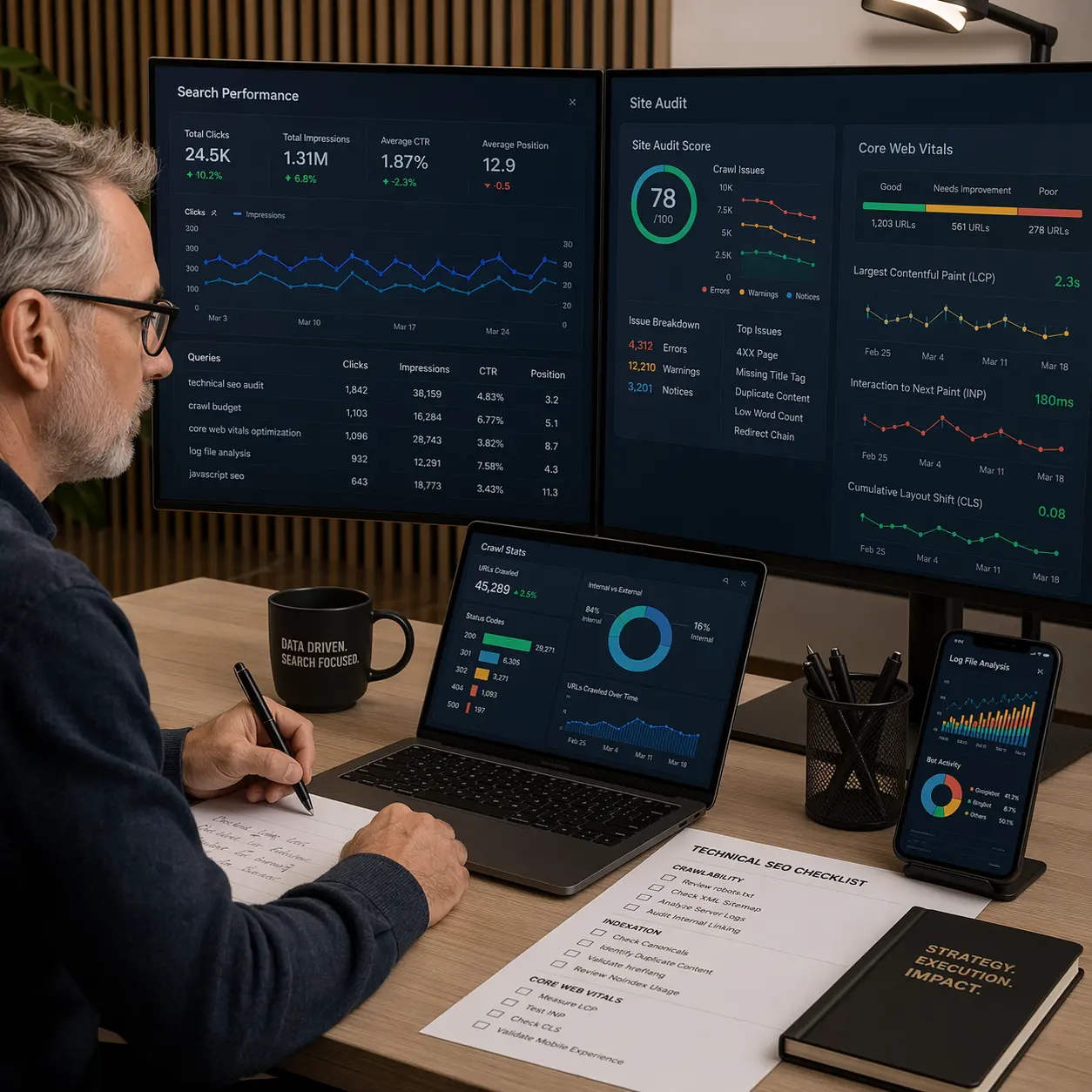
Vision is the quiet upgrade. Opus 4.7 now processes images up to 2,576 pixels on the long side, around 3.75 megapixels. In practical terms, a full Ahrefs dashboard screenshot, a Core Web Vitals report or a Screaming Frog crawl export no longer needs to be cropped, tiled or transcribed before the model can reason over it. That single change removes a significant friction point for teams that run visual diagnostics as part of their technical SEO audit process.
How Does Opus 4.7 Change Agentic SEO and Content Operations
Opus 4.7 changes agentic SEO work by staying on task for longer, following instructions more precisely and recovering from tool failures that would stop earlier models. For content ops, that translates into longer, more trustworthy autonomous runs across briefing, drafting, auditing and internal-link planning, with fewer handback points for human editors.
The observable shift is in what Anthropic calls long-horizon reliability. Warp, Cursor and Hex all reported in launch-day testing that Opus 4.7 clears tasks their previous model harnesses failed on, particularly multi-step work spanning the full 1M token context window. For an SEO content workflow that loads a brand style guide, a topic brief, competitor SERP snapshots, past cluster articles and Search Console query data into the same context, fewer dropped instructions over a long run means fewer articles rewritten at the human review stage.
Instruction-following gains show up most clearly in tasks with tight editorial constraints. Banned words, British English spelling, specific heading character counts, passage-ranking structure requirements and distinct-H2 semantic clustering are exactly the kind of layered instructions that Opus 4.6 sometimes drifted on over long outputs. Harvey's legal testing reports better calibration on ambiguous document editing and sharper distinction between adjacent concepts, which maps almost directly onto editorial briefs that demand confirmed versus speculative distinctions in SEO writing.
There is one cost-side note worth planning for. Opus 4.7 uses an updated tokenizer, so the same input can map to between 1.0 and 1.35 times the token count of Opus 4.6, depending on content type. The model also thinks more on later turns at higher effort levels, which raises output tokens on hard problems. Budget modelling for AI content production pipelines should be rerun before scaling any Opus 4.6 agent wholesale to the new model.
Fun fact: Opus 4.7's image-resolution jump means a single high-detail screenshot of a Google Search Console performance report can now be read end to end without tiling, something that required a custom preprocessor on every Claude model before Opus 4.5.
Where Does This Leave Google AI Overviews and Zero Click Search
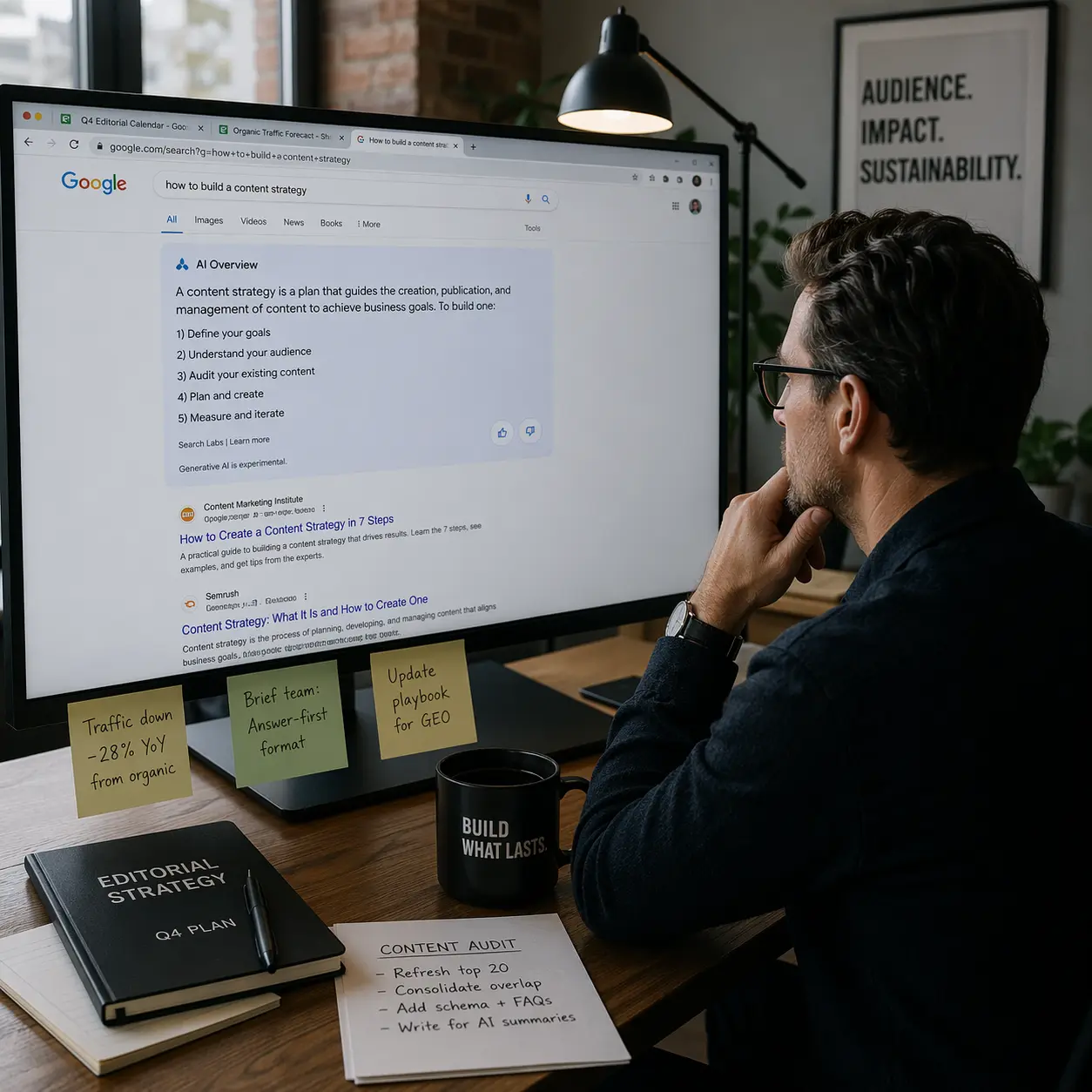
Opus 4.7 does not directly change Google AI Overviews, but it sharpens the argument that publishers and brands need to treat AI-surface optimisation as a distinct discipline from classic SEO. Better frontier models raise the quality bar for synthesised answers, which means citation selection becomes more competitive, not less.
Google's Helpful Content System and SpamBrain remain the proximate gatekeepers for traditional blue-link ranking, and Google has confirmed that E-E-A-T signals inform quality rater guidelines rather than acting as a direct ranking factor. What has changed across the AI-answer layer is the likelihood that a piece of content surfaces as a citation inside an AI Overview or an agent-driven response. Models with sharper reasoning and stronger instruction-following are measurably better at selecting sources that are specific, dated, well-attributed and structurally clean. That is the same specification that feeds passage ranking in classical search, so the two optimisation tracks are starting to converge.
Practitioners should read Opus 4.7 as a signal about the rate of capability gain across the frontier, not as a direct SERP event. The follow-on effect is felt through the tools layer. Every major SEO platform, Ahrefs, Semrush, Screaming Frog and the newer AI-native entrants, is shipping Claude-powered features in the form of audit summarisation, content gap analysis and brief generation. A step change in the underlying model shows up as a step change in tool accuracy within weeks. Content teams that already treat AI-assisted briefs as the first draft for human editors will see that gap close further.
[INTERNAL LINK: AI Overviews citation strategy for publishers | optimising for AI search surfaces]
Which Practical Changes Should SEO Leads Test This Month
SEO leads should test Opus 4.7 across four specific workflows in the first 30 days: technical audit summarisation from screenshots, long-horizon content briefing across the 1M token window, agentic internal-link mapping at site scale, and passage-level rewrite work where instruction-following precision matters most.
Start with visual diagnostics. Run a side-by-side comparison where Opus 4.6 and Opus 4.7 each receive the same Google Search Console screenshot, Lighthouse report or Screaming Frog export and produce a prioritised remediation list. The triple-resolution gain should show up in the accuracy of small-text extraction, chart reading and pattern recognition on Core Web Vitals data. Measure the lift in items correctly identified per report.
Second, rerun your strongest long-form brief generator with Opus 4.7 and hold every other variable constant. Adaptive thinking, which Anthropic now recommends as the default reasoning mode, allocates thinking tokens dynamically rather than forcing a fixed budget. Measure edit distance between model output and the shipped article, and the number of instruction violations per 1,000 words. Teams running multi-persona content production with strict voice rules will see the sharpest difference here.
Third, test agentic internal-linking work. Load your site's cornerstone content map, a fresh Search Console export and a target new article into the context window, and ask the model to return a linking plan with anchor text suggestions and placement rationale. Opus 4.6 was usable for this task on clean sites; Opus 4.7 should be more reliable on sites with layered taxonomies and overlapping topic clusters. The relevant metric is percentage of proposed links a senior editor accepts without modification.
Fourth, push the model on tool-heavy workflows. If your stack includes MCP servers for Search Console, analytics or a CMS, the drop in tool-error rates that Cursor reported should show up as fewer stalled runs and fewer silent completions. Log tool-call success rates per 100 calls before and after the switch.
What the Mythos Context Means for Anthropic Strategy and Search
Opus 4.7 is the commercial ship; Claude Mythos Preview is the model Anthropic is holding back. Mythos scored 77.8% on SWE-bench Pro against Opus 4.7's 64.3%, and Anthropic has declined general release citing cybersecurity and safety concerns managed through Project Glasswing, expected to be unveiled in San Francisco in May 2026.
For SEO and digital strategy, the Mythos framing matters for two reasons. The first is capability horizon. Anthropic is publicly confirming that a stronger model exists and is not being shipped, which sets a clearer ceiling on how much further frontier general-availability models can advance in the next two release cycles. The second is safety posture. Anthropic has implemented cyber safeguards in Opus 4.7 that automatically detect and block requests indicating prohibited or high-risk cybersecurity uses, and reduced the model's cyber capabilities during training compared with Mythos Preview. Security-focused teams can access a less restricted variant through Anthropic's new Cyber Verification Program.
For agency and in-house SEO operators, that posture changes the vendor risk calculation in a subtle but useful way. A model that is explicitly scoped, with documented cadence of release approximately every two months since Opus 4.5 in February 2026, is easier to build around than a frontier target that moves without warning. Predictable cadence allows longer commitments to prompt libraries, tool harnesses and agent architectures without constant rewrites. That matters more for multi-client SEO reporting dashboards, content engines and B2B lead generation agents than any single benchmark score.
[INTERNAL LINK: Claude model cadence and production planning | choosing the right Claude tier for marketing stacks]
Where This Leaves Search Teams Heading into Q2 2026
Opus 4.7 is the clearest signal yet that the useful ceiling for AI in SEO and content operations is not the top-line benchmark number. It is the combination of instruction-following precision, vision fidelity, tool-call reliability and long-horizon stability. The teams that benefit most are the ones that have already invested in structured prompts, clean tool harnesses and editorial review loops, because they can absorb a capability uplift without rebuilding their stack.
Upgrade decisions should be run on measured outcomes, not marketing copy. Swap the model in one workflow, hold every other variable, and compare edit distance, tool-error rates and review-acceptance percentages over two weeks. Think of Claude Opus 4.7 as a sharper tool in the same toolbox, not a new trade. The carpenters still do the work; a better chisel just takes a cleaner cut.