
When Google expanded AI Overviews to UK users in 2024, following the US rollout, many SEO teams noticed something specific in their Google Search Console data before they had read a single industry report about it: impressions for informational queries held steady or increased, but click-through rates on those same queries fell. The impression data showed the content was still appearing in search results. The click data showed fewer users were following through to the page. Understanding what that pattern means — and what it does not mean — is the productive starting point for any practitioner adjusting strategy around AI Overviews in 2026.
The confirmed picture of AI Overviews is narrower than most commentary suggests. Google has documented that AI Overviews appear on a subset of queries and are designed to help users understand topics and find the information they need. Google has also stated publicly, through Search Liaison Danny Sullivan, that links appearing within AI Overview answers drive higher-quality clicks with above-average engagement. What has not been confirmed by Google is the specific percentage of queries that trigger AI Overviews, the exact criteria for Overview appearance, or the net traffic impact across all site types. Those figures circulating in SEO communities are observational estimates, not Google disclosures.
This article applies the confirmed-vs-speculative distinction systematically to AI Overviews in UK SERPs, with specific attention to how practitioners should read their Search Console data and what the evidence justifies changing in content strategy.
What Google has confirmed about how AI Overviews work
Google's Search Central documentation describes AI Overviews as drawing on information from across the web to provide a synthesised response, with links to relevant sources. The generation mechanism relies on Google's large language models integrated with its search index, which means AI Overview content reflects Google's assessment of source quality and relevance rather than a simple match to the query terms. Google has confirmed that the system can decline to show an AI Overview for queries where a synthesised response would not be useful or where the topic requires medical, legal, or financial caution — a category Google calls sensitive topics.
What Google has not confirmed is a complete taxonomy of trigger conditions. Practitioner observation across UK SERPs as of early 2026 suggests AI Overviews appear most frequently on informational queries with a broad research intent, comparatively rarely on transactional or navigational queries, and inconsistently on queries with strong commercial intent. These are widely observed patterns; they are not documented specifications from Google. Treating observed trigger patterns as confirmed criteria in a content strategy risks optimising for a model that Google can and does adjust without announcement.
Fun fact: Google's AI Overviews, introduced in the US as part of Search Generative Experience in May 2023 before UK rollout, draw on Google's Gemini models integrated directly into the search ranking and retrieval pipeline, making them structurally different from a chatbot that searches the web separately.
Reading the CTR divergence in Google Search Console
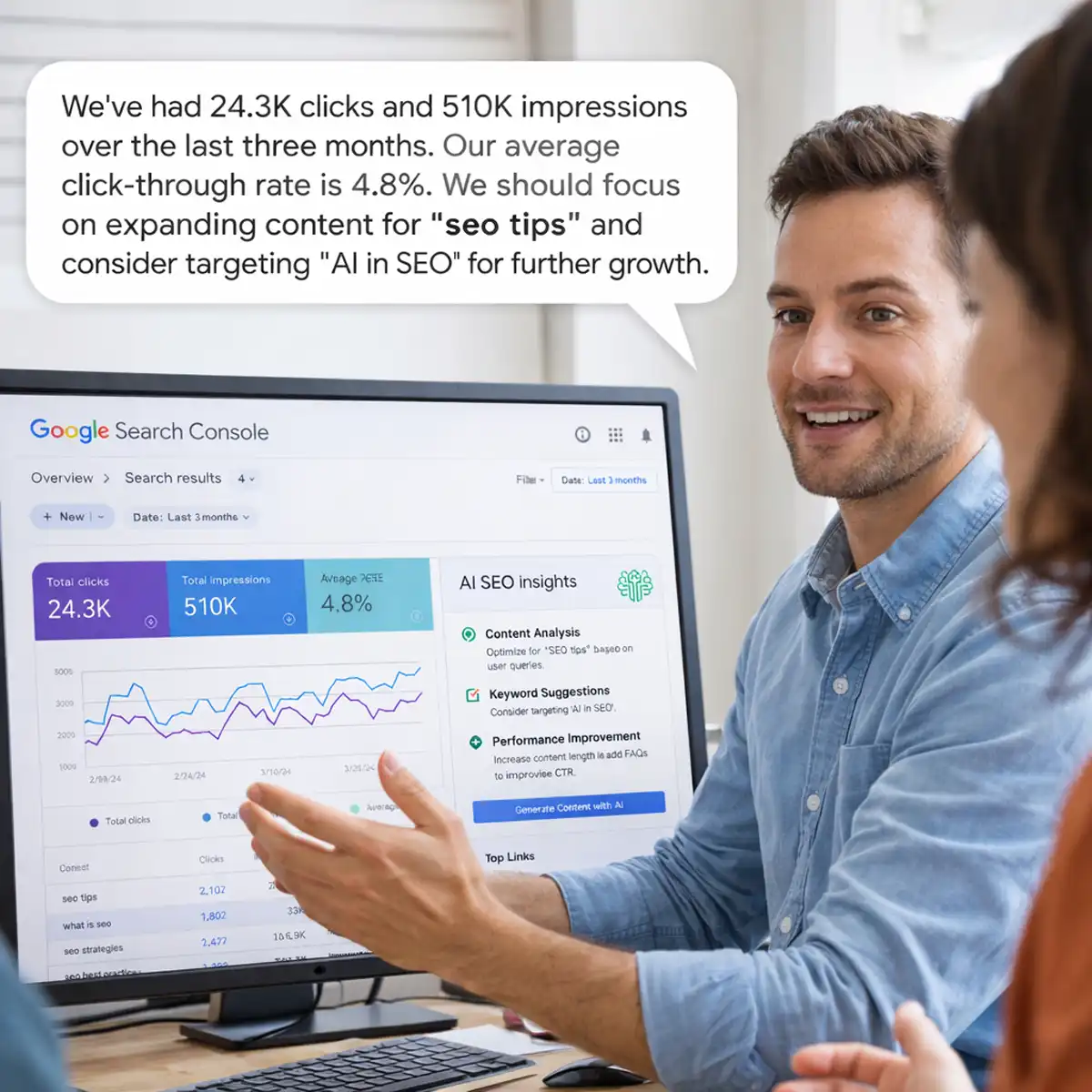
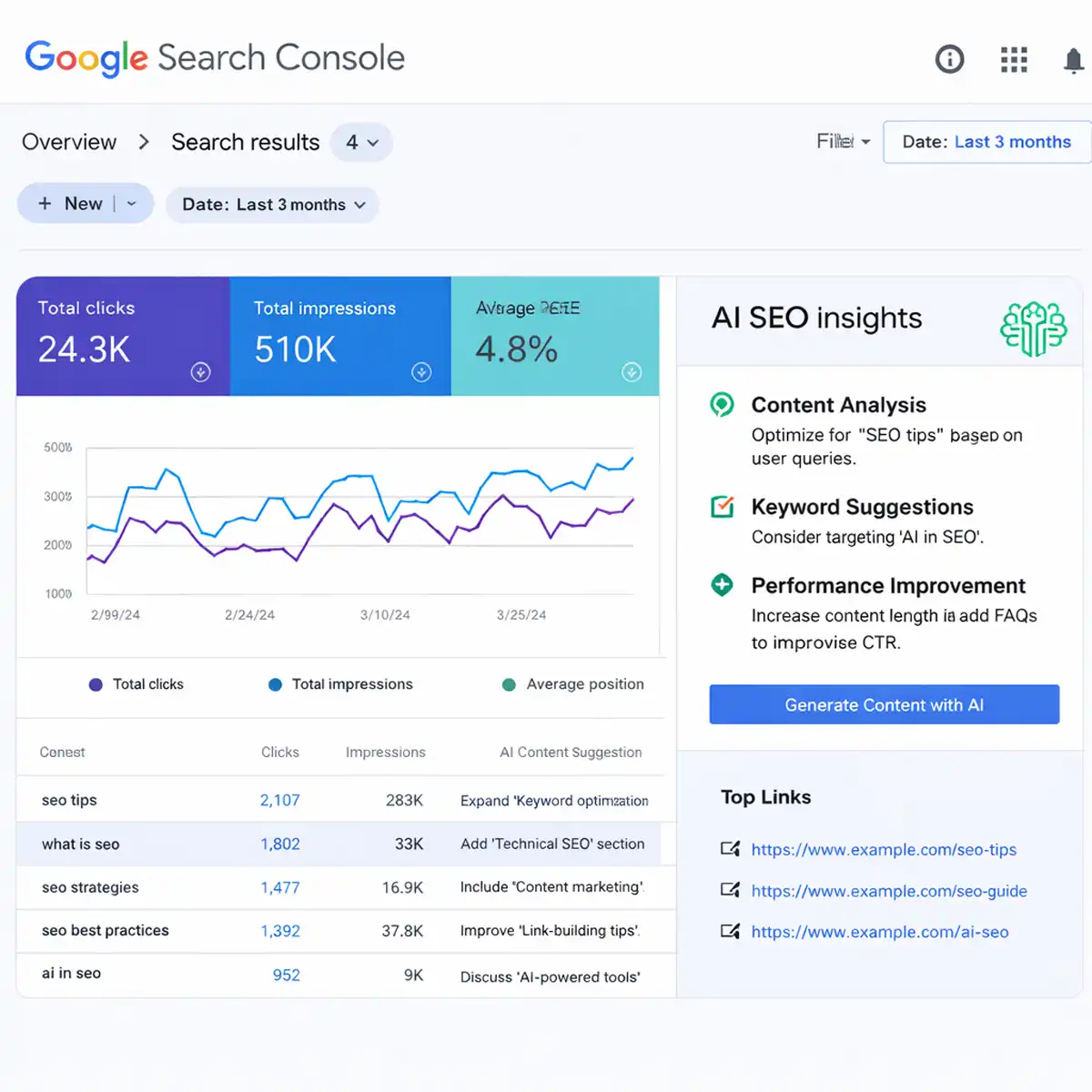
The diagnostic starting point for AI Overview impact is the Google Search Console Performance report. Filter to queries where impressions are stable or growing over a 3-month period, but CTR has declined by 2 percentage points or more. Export this query set and segment by query type: branded queries, informational long-tail queries, and commercial investigation queries. A concentration of CTR decline in the informational long-tail segment, with branded and commercial queries unaffected, is consistent with AI Overview's presence on those informational queries.
The critical caution here is what this pattern does not confirm. A CTR decline on informational queries is also consistent with featured snippet displacement, SERP layout changes, People Also Ask expansion, and seasonal intent shifts. Google Search Console does not yet provide a filter to identify queries where an AI Overview appeared during the impression period, which means practitioners cannot directly attribute CTR change to AI Overview presence from GSC data alone. The pattern is suggestive; it is not diagnostic without corroborating SERP observation.
The practical check: search the affected queries in UK SERPs manually, with location set to United Kingdom and personalisation disabled (private browsing, VPN if needed). Document whether an AI Overview is present for each query in your CTR-declining set. If AI Overviews are present on 60% or more of your high-impression declining queries, the pattern has a plausible mechanism. If they appear on fewer than 30%, other SERP changes are the more likely explanation.
Which content appears inside AI Overviews, and what does that mean?
Google has confirmed that links within AI Overview answers drive higher-quality clicks, and that content appearing in AI Overviews tends to be from sources Google considers authoritative and well-structured. The confirmed implication is that content meeting Google's quality standards — demonstrating E-E-A-T, providing direct answers to specific questions, using clear structure with H2 and H3 organisation — has a higher probability of AI Overview inclusion than content without these characteristics. This is not a separate "AI Overview optimisation" strategy; it is the same quality standard that Google has documented for search quality generally.
What is not confirmed is that structured content with passage-level formatting is a specific AI Overview ranking factor independent of general quality assessment. Practitioner claims that specific formatting choices (bullet points, definition-first paragraphs, specific word counts) trigger AI Overview inclusion are based on correlational observation rather than any documented mechanism. Acting on these claims is reasonable as a hypothesis; presenting them as confirmed optimisation strategies overstates the evidence.
The forward-looking consideration for UK publishers: Google's stated direction is toward AI Overviews for an expanding proportion of queries, with the system calibrating based on user engagement signals. Content that serves a genuine informational need with depth and accuracy is more likely to remain relevant as the system develops. Content that exists primarily to capture a ranking position for an informational query, without substantive depth, faces increasing displacement risk as AI-synthesised answers improve in quality.
The UK-specific context that the US data does not address
AI Overviews rolled out to UK users later than to US users, and the UK SERP landscape has characteristics that make direct application of US-origin data unreliable. UK search volumes for many informational queries are materially smaller than US equivalents, which affects the confidence of any AI Overview trigger data collected through SERP observation tools. UK user behaviour in response to AI Overviews may differ from US patterns; the IAB UK and JICWEBS datasets on UK search behaviour provide UK-specific baseline data that US studies cannot substitute.
The UK regulatory context adds a dimension that most SEO commentary ignores. The Competition and Markets Authority has been actively reviewing Google's AI integration into search through its ongoing investigation into AI Foundation Models and their intersection with search markets. This regulatory scrutiny has no direct operational implication for practitioners, but it does mean that AI Overview behaviour in UK SERPs could be subject to constraints not present in other markets. Monitoring the CMA's AI Foundation Models review outputs alongside SERP observation provides a fuller picture of the UK-specific environment than SERP data alone.
Ask your own data the right question before adjusting the strategy
The practitioner's question that AI Overviews actually require is narrow and specific: are the queries where I am losing CTR the queries where AI Overviews are appearing, and if so, is my content a candidate for inclusion in those answers, or is it being displaced entirely? The first part of that question is answerable with the GSC diagnostic and SERP observation method described above. The second part requires assessing whether the content provides the kind of direct, well-structured, source-credible information that Google's AI systems are selecting from.
If the content is substantively informative and well-structured and still not appearing in AI Overview citations, the priority is external backlink profile and entity authority rather than content reformatting. If the content is thin or primarily optimised for keyword density rather than genuine informational depth, the AI Overview displacement is consistent with Google's stated direction, and the response is an editorial one. The sites that will sustain organic visibility through the continued development of AI Overviews in UK SERPs are not the ones with the most aggressive AI Overview optimisation tactics — they are the ones whose content would have met a rigorous quality standard regardless. That is not reassuring. It is, however, the accurate read of what Google has confirmed.